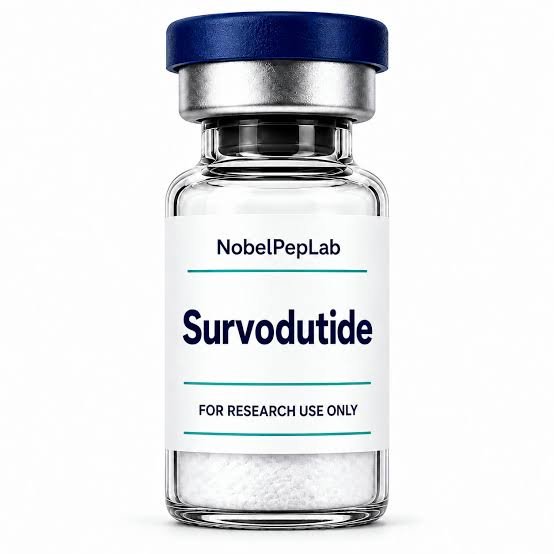
Understanding Survodutide
Survodutide is a dual GLP-1/glucagon agonist that is mechanistically different from tirzepatide’s GLP-1/GIP pairing. The reference discusses obesity and liver-disease development and separates different trial populations and analysis methods.
Survodutide
Dual GLP-1/glucagon agonist
Obesity research
Clinical development
Liver-disease research
MASH development
Weekly SC research
Phase 2 clinical-trial context
No approved personal regimen
Trial dosing should not be treated as personal treatment guidance.
Evidence interpretation
Different trial populations and analysis methods should not be treated as direct head-to-head comparisons.
Important Evidence Note
Survodutide is being studied in obesity and liver-disease contexts, but the reference does not identify an approved personal dosing regimen. Trial completer results and main-analysis outcomes should not be merged or interpreted as interchangeable evidence.
Survodutide Reported Dose Patterns
The reference describes Phase 2 weekly subcutaneous trial arms with escalation and a 46-week treatment period. Phase 3 and MASH programs are separate research contexts and should not be interpreted as a universal personal dosing protocol.
SC example
Per administration
Frequency
Daily total
Reported cycle
Phase 2 Weekly SC Arms
0.6 / 2.4 / 3.6 / 4.8 mg SC weekly
Weekly
Not applicable; weekly dosing
Up to 20-week escalation; 46-week treatment
Phase 3 Program
Trial-specific dosing
Trial-specific
Not applicable; trial-specific
Separate Phase 3 research program
MASH Program
Trial-specific dosing
Trial-specific
Not applicable; trial-specific
Separate MASH research program
Per administration
0.6 / 2.4 / 3.6 / 4.8 mg SC weekly
Daily total
Not applicable; weekly dosing
Reported cycle
Up to 20-week escalation; 46-week treatment
Per administration
Trial-specific dosing
Daily total
Not applicable; trial-specific
Reported cycle
Separate Phase 3 research program
Per administration
Trial-specific dosing
Daily total
Not applicable; trial-specific
Reported cycle
Separate MASH research program
The reported Phase 2 doses are clinical-trial arms, not an approved personal regimen. Phase 3 and MASH programs represent separate research contexts, and trial populations and analysis methods should not be treated as directly interchangeable.
Research-Stage Clinical Context
Survodutide has been studied in clinical development programs for obesity and liver disease, but the reference identifies no approved personal regimen. Reported trial doses should not be converted into individualized treatment instructions.
Survodutide Safety Considerations
The reference reports gastrointestinal symptoms and treatment discontinuation as important safety and tolerability considerations. Trial populations and estimands also affect how efficacy and tolerability findings should be interpreted.
Survodutide Storage and Product Handling
Cold / Dark Guidance
The source provides cold/dark storage guidance.
Research Formulation
Source storage guidance is not validated stability for every research formulation.
Formulation Difference
Storage stability may differ between specific research formulations.
Product Verification
Verify the exact formulation and product-specific storage instructions before interpreting storage requirements.
Survodutide Concentration Calculator
The reference provides independently recomputed mathematical concentration examples. These calculations are examples only and are not mixing or administration instructions.
Amount (mg)
Final volume (mL)
Concentration (mg/mL)
Per 1 U (mcg)
Per 10 U (mcg)
U means a U-100 volume marking: 1 U = 0.01 mL. These are mathematical examples only, not mixing or administration instructions.
Survodutide Clinical Findings
Survodutide has been studied in obesity and liver-disease development programs. The reference reports different results depending on the analysis population and emphasizes that Phase 2 completer and primary-analysis estimates should not be treated as equivalent.
Phase 2 Research
Phase 2 weekly subcutaneous arms included 0.6, 2.4, 3.6, and 4.8 mg after up to 20 weeks of escalation, followed by a 46-week treatment period.
SYNCHRONIZE-1
The source reports 16.6% versus 3.2% placebo weight loss at 76 weeks in SYNCHRONIZE-1.
Evidence Interpretation
Phase 2 completer and primary-analysis estimates differed substantially, and different trial populations and analysis methods should not be treated as direct head-to-head comparisons.
Survodutide Regulatory Status
Research-Stage Clinical Context
The reference describes Survodutide through obesity and liver-disease development programs and does not identify an approved personal regimen. Clinical-trial dosing should not be presented as an approved or individualized treatment protocol.
Survodutide remains a research-stage compound in the contexts described by the reference. Reported clinical findings should be interpreted according to the specific trial population, endpoint, and analysis method.