Understanding Selank
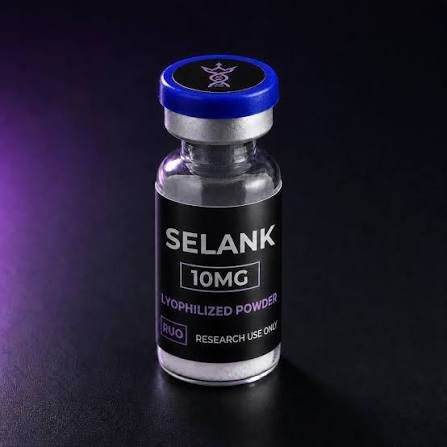
Selank is a synthetic peptide related to tuftsin and is discussed in research involving anxiety, mood and cognitive effects. Russian nasal clinical research provides route-specific context, while subcutaneous schedules are primarily described as community practices. These routes and formulations should not be treated as interchangeable.
Compound Type
Tuftsin-related synthetic peptide
Research Focus
Anxiety, mood and cognitive research
Reported Routes
Intranasal and subcutaneous contexts are described separately.
Related Formulations
Ordinary Selank and modified N-acetyl products
Evidence Status
Limited controlled evidence, with Russian nasal clinical research providing the most direct route-specific context described in the source.
Important Formulation Note
Modified N-acetyl Selank products and ordinary Selank should not be assumed equivalent merely because commercial listings group them together. Their formulations and supporting evidence may differ.
Selank Protocol Patterns
The source describes subcutaneous community examples and intranasal use patterns separately. These are reported research and community contexts, not validated personal treatment recommendations.
SC example
Per administration
Frequency
Daily total
Reported cycle
Subcutaneous Community Example
Weeks 1–2: 250–300 mcg/day; weeks 3–4: 400–500 mcg/day; weeks 5–8: off; weeks 9–12: 300–500 mcg/day
Daily during reported community periods
250–300 mcg/day; 400–500 mcg/day; later 300–500 mcg/day
Weeks 1–4, followed by weeks 5–8 off, then weeks 9–12
Intranasal Reported Pattern
600–2,700 mcg/day, divided into 2–3 administrations
2–3 times daily
600–2,700 mcg/day
14–21 days, followed by 1–3 weeks off
Alternative Nasal Course
600–2,700 mcg/day, divided into 2–3 administrations; course variations are reported.
2–3 times daily during the reported course
600–2,700 mcg/day
14–21 days, followed by 1–3 weeks off; other cycle variations are reported.
Subcutaneous Community Example
Per administration
Weeks 1–2: 250–300 mcg/day; weeks 3–4: 400–500 mcg/day; weeks 5–8: off; weeks 9–12: 300–500 mcg/day
Frequency
Daily during reported community periods
Daily total
250–300 mcg/day; 400–500 mcg/day; later 300–500 mcg/day
Reported cycle
Weeks 1–4, followed by weeks 5–8 off, then weeks 9–12
Intranasal Reported Pattern
Per administration
600–2,700 mcg/day, divided into 2–3 administrations
Frequency
2–3 times daily
Daily total
600–2,700 mcg/day
Reported cycle
14–21 days, followed by 1–3 weeks off
Per administration
600–2,700 mcg/day, divided into 2–3 administrations; course variations are reported.
Frequency
2–3 times daily during the reported course
Daily total
600–2,700 mcg/day
Reported cycle
14–21 days, followed by 1–3 weeks off; other cycle variations are reported.
The individual Selank page reports higher nasal totals than the Russian Nootropic Stack page. These differences should not be merged into one universal schedule.
Reported Use Is Not a Validated Prescription
Subcutaneous community practices do not establish clinical effectiveness or safety. Nasal clinical context does not validate injected schedules, route superiority or modified N-acetyl products.
Selank Safety Considerations
The source describes local and nasal reactions, headache and variable sedation or activation reports. Controlled safety evidence remains limited, and drug-interaction concerns are not fully established.
Selank Storage and Product Handling
Storage Context
The source reports storage of mixed Selank formulations at 2–8°C.
Reported Storage Period
The source describes a typical period of 3–4 weeks after mixing, but this has not been independently validated.
Formulation Differences
Ordinary Selank and modified N-acetyl products should not be assumed to have identical stability characteristics.
Product Verification
Product-specific manufacturer documentation and formulation details should take priority. The source’s reported storage period is not a universal stability guarantee.
Selank Concentration Calculator
The source provides independently calculated examples using different assumed amounts and final volumes. These figures demonstrate concentration arithmetic only and do not establish a suitable formulation or administration amount.
Amount (mg)
Final volume (mL)
Concentration (mg/mL)
Per 1 U (mcg)
Per 10 U (mcg)
10
1
10 mg/mL
100 mcg
1,000 mcg
10
2
5 mg/mL
50 mcg
500 mcg
Concentration (mg/mL)
10 mg/mL
Concentration (mg/mL)
5 mg/mL
Source examples: 10 mg / 1 mL = 10 mg/mL; 10 mg / 2 mL = 5 mg/mL; 30 mg / 3 mL = 10 mg/mL; 30 mg / 6 mL = 5 mg/mL; 30 mg / 10 mL = 3 mg/mL. U means a U-100 volume marking: 1 U = 0.01 mL. These are mathematical examples, not mixing or administration instructions. They do not establish sterility, compatibility, stability or suitability for injection.
Selank Clinical Findings
Selank has a history of Russian nasal clinical research. However, evidence from one route or formulation does not automatically establish the effectiveness of another route, modified formulation or community-reported schedule.
Russian Nasal Research
Russian nasal studies provide limited clinical context for Selank, particularly in research involving anxiety-related outcomes.
Route-Specific Evidence
Nasal clinical research does not establish the effectiveness or safety of subcutaneous community schedules. Different routes require separate evidence.
Formulation Differences
Modified N-acetyl Selank products are not automatically equivalent to ordinary Selank. Their evidence and formulation characteristics must be considered separately.
Selank Regulatory Status
Research and Regional Clinical Context
The source describes Russian clinical use and research contexts for nasal Selank. This does not establish universal regulatory approval or validate independently sourced research-vial products and subcutaneous community schedules.
Educational information only. Not medical advice, diagnosis or treatment guidance. Research findings and community-reported practices should not be interpreted as proof of safety or effectiveness. Consult a qualified healthcare professional for medical questions.