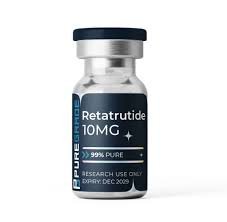
Understanding Retatrutide
Retatrutide is a triple agonist that targets GLP-1, GIP and glucagon receptors. It is being studied in clinical development programs involving obesity and metabolic outcomes. Trial schedules, assigned treatment arms and supervised dose escalation must be distinguished from community sourcing and individualized use.
Compound Name
Retatrutide
Compound Type
GLP-1 / GIP / Glucagon triple-receptor agonist
Primary Research Area
Obesity and metabolic research
Mechanism
Activates GLP-1, GIP and glucagon receptors.
Administration Route
Subcutaneous (SC) in the clinical-trial schedules described in the source.
Development Status
Investigational compound in clinical development; trial evidence does not establish equivalence with research-vial products.
Important Clinical Research Note
Retatrutide trial formulations, assigned treatment arms and supervised escalation schedules are distinct from products obtained through research-vial suppliers. Clinical-trial results should not be treated as instructions for personal use.
Retatrutide Research Protocols
The source describes Phase 2 initial-to-target treatment arms and a Phase 3 weekly subcutaneous schedule. These are clinical-trial research details, not a universal personal dosing ladder or self-administration instructions.
SC example
Per administration
Frequency
Daily total
Reported cycle
Phase 3 Weekly Trial Schedule
Weeks 1–4: 2 mg; weeks 5–8: 4 mg; weeks 9–12: 6 mg; weeks 13–16: 9 mg; week 17 onward: 12 mg
Once weekly in the described Phase 3 trial schedule
Not applicable — weekly trial schedule
Phase 3 schedule described through week 17 and beyond
Phase 2 Initial-to-Target Arms
Reported initial-to-target arms: 1 → 1 mg; 2 → 4 mg; 4 → 4 mg; 2 → 8 mg; 4 → 8 mg; 2 → 12 mg
Weekly trial arms; individual study assignments differ.
Not applicable — weekly trial arms
Phase 2 initial-to-target treatment arms
Clinical Trial Duration
Trial durations reported include 48, 68 and 80 weeks.
Study-dependent
Not applicable — duration is measured in weeks
48 / 68 / 80 weeks across reported trial contexts
Phase 3 Weekly Trial Schedule
Per administration
Weeks 1–4: 2 mg; weeks 5–8: 4 mg; weeks 9–12: 6 mg; weeks 13–16: 9 mg; week 17 onward: 12 mg
Frequency
Once weekly in the described Phase 3 trial schedule
Daily total
Not applicable — weekly trial schedule
Reported cycle
Phase 3 schedule described through week 17 and beyond
Phase 2 Initial-to-Target Arms
Per administration
Reported initial-to-target arms: 1 → 1 mg; 2 → 4 mg; 4 → 4 mg; 2 → 8 mg; 4 → 8 mg; 2 → 12 mg
Frequency
Weekly trial arms; individual study assignments differ.
Daily total
Not applicable — weekly trial arms
Reported cycle
Phase 2 initial-to-target treatment arms
Per administration
Trial durations reported include 48, 68 and 80 weeks.
Frequency
Study-dependent
Daily total
Not applicable — duration is measured in weeks
Reported cycle
48 / 68 / 80 weeks across reported trial contexts
Trial arms and target doses vary by study. These schedules must not be interpreted as a universal personal escalation plan.
Investigational Trial Information
The schedules shown are research-trial descriptions. They do not establish a safe personal dose, a suitable escalation schedule or equivalence with commercially sourced research vials.
Retatrutide Safety Considerations
The source identifies gastrointestinal effects, heart-rate changes and dysesthesia as relevant safety concerns. Tolerability and risk should be interpreted within the clinical-trial context.
Retatrutide Storage and Product Handling
Storage Information
The source does not establish a validated generic storage temperature for research-vial formulations.
Mixed Product Stability
No validated generic discard period is established for research-vial products.
Clinical Trial Formulations
Clinical-trial formulations and independently sourced research products should not be assumed to have identical formulation or stability characteristics.
Product Verification
Product identity, formulation and manufacturer documentation require verification. Do not assume that a research-vial label establishes clinical-trial equivalence.
Retatrutide Concentration Calculator
The source provides independently calculated concentration examples for different assumed amounts and volumes. These are mathematical examples only, not product-specific preparation or administration instructions.
Amount (mg)
Final volume (mL)
Concentration (mg/mL)
Per 1 U (mcg)
Per 10 U (mcg)
5
1
5 mg/mL
50 mcg
500 mcg
10
2
5 mg/mL
50 mcg
500 mcg
Concentration (mg/mL)
5 mg/mL
Concentration (mg/mL)
5 mg/mL
Source examples: 5 mg / 1 mL = 5 mg/mL; 10 mg / 2 mL = 5 mg/mL; 12 mg / 1.2 mL = 10 mg/mL; 20 mg / 2 mL = 10 mg/mL; 30 mg / 3 mL = 10 mg/mL. U means a U-100 volume marking: 1 U = 0.01 mL. These are independent mathematical examples, not mixing or administration instructions. They do not verify the identity, sterility, concentration or suitability of any commercial vial.
Retatrutide Clinical Findings
The source reports substantial weight-loss findings across different clinical development programs. Different trial populations, durations and analysis methods must be kept separate rather than presented as direct head-to-head comparisons.
Phase 2 Research
The source reports weight loss of up to 24.2% at 48 weeks in Phase 2 research.
TRIUMPH-4 Findings
The source reports 28.7% weight loss at 68 weeks in TRIUMPH-4, involving a different study population.
Different Trial Contexts
Phase 2 and TRIUMPH-4 results are not direct head-to-head estimates. Differences in study populations, duration and analysis methods matter when interpreting reported outcomes.
Retatrutide Regulatory Status
Investigational Compound
Retatrutide is described in the source as a compound in clinical development. Clinical-trial results do not establish regulatory approval or prove that independently sourced research-vial products are equivalent to trial formulations. The source does not establish an approved personal-use protocol.
Educational information only. Not medical advice, diagnosis or treatment guidance. Retatrutide trial schedules and research findings should not be used as personal dosing instructions. Consult a qualified healthcare professional for medical questions.