Understanding Pinealon
Pinealon is an EDR tripeptide discussed in neuronal and oxidative-stress research. The available literature is limited, and reported short-course traditions should not be interpreted as proven human efficacy or safety protocols.
Compound Type
EDR tripeptide
Research Focus
Neuronal and oxidative-stress research
Formulation Shown
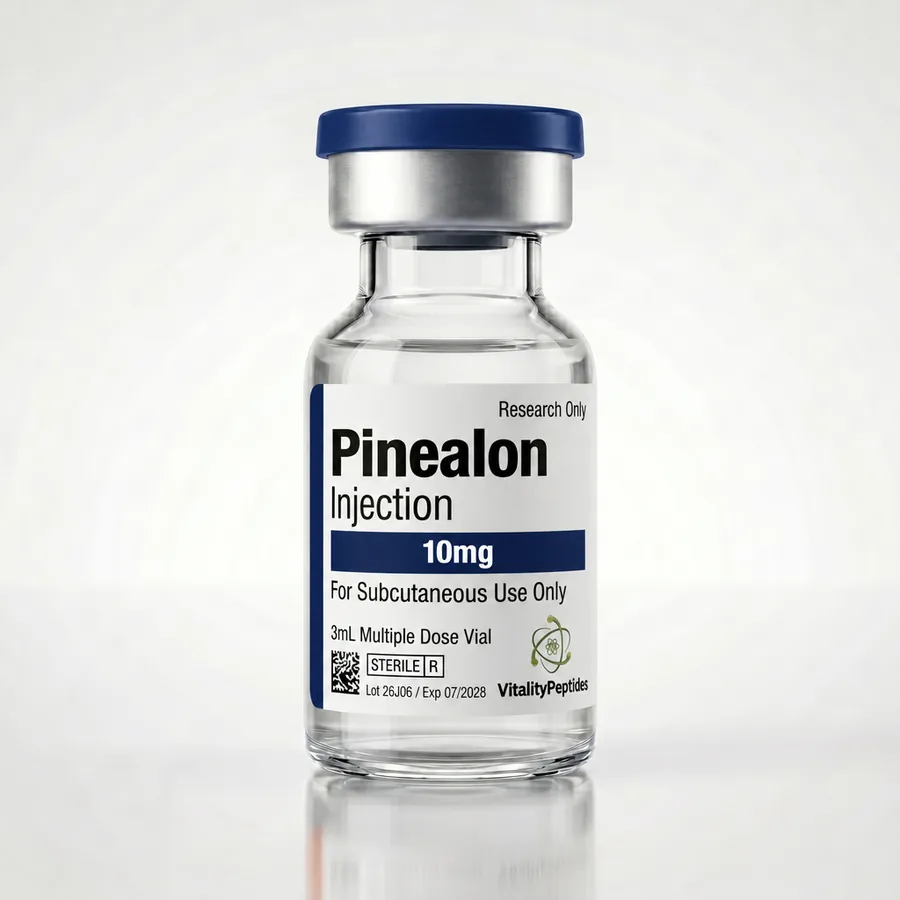
Injection vial labelled 10 mg / 3 mL
Reported Routes
Subcutaneous and oral contexts are described separately in community reports.
Evidence Status
Limited research literature; no validated human efficacy or safety protocol established by the source.
Important Research Note
Community-reported cycles are not established medical protocols. Oral and injected amounts are different route-specific contexts and must not be treated as interchangeable.
Pinealon Protocol Patterns
The following are reported community examples from the reference material. They are not medical recommendations, validated treatment schedules or instructions for self-administration.
SC example
Per administration
Frequency
Daily total
Reported cycle
Reported SC Community Example
Days 1–5: 1 mg/day; days 6–14: 1.5 mg/day; days 15–20: 2 mg/day
Daily, as reported
1 mg → 1.5 mg → 2 mg per day across the reported periods
20-day reported course
Alternative Higher-Dose Reports
Some sources discuss 5–10 mg/day.
Frequency details not specified in source
5–10 mg/day reported; context and schedule are not fully specified
Not specified in source
Reported Oral Community Example
20 mg/day
Daily, as reported
20 mg/day reported
10–20 days, sometimes 28 days; some reports describe 2–3 courses per year with 2–3 months between courses
Reported SC Community Example
Per administration
Days 1–5: 1 mg/day; days 6–14: 1.5 mg/day; days 15–20: 2 mg/day
Frequency
Daily, as reported
Daily total
1 mg → 1.5 mg → 2 mg per day across the reported periods
Reported cycle
20-day reported course
Alternative Higher-Dose Reports
Per administration
Some sources discuss 5–10 mg/day.
Frequency
Frequency details not specified in source
Daily total
5–10 mg/day reported; context and schedule are not fully specified
Reported cycle
Not specified in source
Reported Oral Community Example
Per administration
20 mg/day
Frequency
Daily, as reported
Daily total
20 mg/day reported
Reported cycle
10–20 days, sometimes 28 days; some reports describe 2–3 courses per year with 2–3 months between courses
These are community-reported patterns, not validated human protocols. Route-specific amounts are not interchangeable.
Not a Validated Treatment Schedule
Short-course traditions and community reports do not establish human effectiveness, long-term safety or an appropriate dose. The source describes limited research literature and does not establish a validated human injection protocol.
Pinealon Safety Considerations
Human safety information is sparse. Reported symptoms do not have reliable incidence rates, and long-term safety has not been established.
Storage and Product Handling
Storage Context
The source describes cold and light-protected vial storage.
Light Protection
Protect the product from light, according to the source’s handling context.
Formulation Stability
Stability depends on the specific formulation. A universal mixed-product shelf life is not established.
Product Verification
Check the actual product label and manufacturer documentation. The image shows a 10 mg / 3 mL vial, but does not establish storage stability or product quality.
Pinealon Concentration Calculator
The source provides independent concentration examples using a 20 mg amount. The pictured product is labelled 10 mg / 3 mL, so its label-based arithmetic is shown separately below. These calculations are educational examples only, not preparation or administration instructions.
Amount (mg)
Final volume (mL)
Concentration (mg/mL)
Per 1 U (mcg)
Per 10 U (mcg)
20
2
10 mg/mL
100 mcg
1,000 mcg
10
3
3.333 mg/mL
33.33 mcg
333.3 mcg
Concentration (mg/mL)
10 mg/mL
Concentration (mg/mL)
3.333 mg/mL
Source examples: 20 mg / 2 mL = 10 mg/mL; 20 mg / 3 mL = 6.667 mg/mL; 20 mg / 4 mL = 5 mg/mL. The pictured 10 mg / 3 mL label gives 3.333 mg/mL by arithmetic. U refers to a U-100 volume marking: 1 U = 0.01 mL. These figures do not verify the vial contents, sterility, suitability or actual concentration. They are not mixing or administration instructions.
Clinical Findings and Research Limitations
Pinealon research includes laboratory oxidative-stress observations and small older reports. These findings do not provide modern proof of human cognitive protection or clinical neuroprotection.
Oxidative-Stress Research
Laboratory observations have explored Pinealon in relation to oxidative-stress pathways. Such findings do not establish clinical benefits in humans.
Limited Human Evidence
Small older reports and limited research literature are not modern proof of cognitive protection, improved memory or neuroprotection in humans.
EDR Identity
Pinealon is identified as an EDR tripeptide. It should be distinguished from other named bioregulators rather than assuming that their findings apply to Pinealon.
Regulatory Status & Disclaimer
Research Use Only
The pictured vial is labelled “Research Only.” This label does not establish approval for human use. The source does not establish a validated human therapeutic protocol, approved dosing schedule or proven clinical benefit for Pinealon.
Educational information only. Not medical advice, diagnosis or treatment guidance. Research findings and community-reported practices should not be interpreted as proof of safety or effectiveness. Always consult a qualified healthcare professional about medical questions.