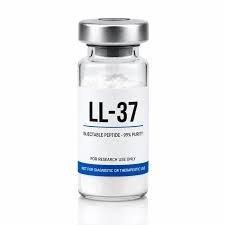
What Is LL-37?
LL-37 is a human antimicrobial host-defense peptide associated with the innate immune system. It has been investigated for antimicrobial activity, immune signaling, inflammatory responses and wound healing. Research involving topical gel formulations should be distinguished from community-reported injectable use.
Peptide Type
Human antimicrobial host-defense peptide.
Primary Function
Antimicrobial activity and innate immune signaling.
Research Areas
Wound healing, antimicrobial activity and inflammatory signaling.
Research Formulations
Topical gel studies and separately reported research-vial formulations.
Evidence Status
Clinical wound-healing evidence described in the source concerns topical gel. Human evidence does not establish the safety or effectiveness of subcutaneous injection.
Topical and Injectable Evidence Are Different
Clinical wound studies investigated topical LL-37 gel. These findings cannot be used to establish systemic antimicrobial effects, injectable wound-repair benefits or the safety of subcutaneous administration.
Reported LL-37 Schedules
The following information separates community-reported subcutaneous amounts from topical clinical research concentrations. These are different research contexts and should not be interpreted as interchangeable treatment protocols.
SC example
Per administration
Frequency
Daily total
Reported cycle
Community SC — Lower Range
100–200 mcg
Daily (community-reported)
100–200 mcg/day
Often reported as five days per week for 2–4 weeks, followed by a break.
Community SC — Lower Range
Up to 500 mcg
Daily (community-reported)
Up to 500 mcg/day
Often reported as five days per week for 2–4 weeks, followed by a break.
Topical Gel Research
0.5–1.6 mg/mL; an early study also used 3.2 mg/mL.
Twice weekly in topical trials (source-reported).
Not applicable — topical study concentrations, not daily systemic amounts.
Study-specific topical treatment schedules.
Community SC — Lower Range
Per administration
100–200 mcg
Frequency
Daily (community-reported)
Daily total
100–200 mcg/day
Reported cycle
Often reported as five days per week for 2–4 weeks, followed by a break.
Community SC — Lower Range
Per administration
Up to 500 mcg
Frequency
Daily (community-reported)
Daily total
Up to 500 mcg/day
Reported cycle
Often reported as five days per week for 2–4 weeks, followed by a break.
Per administration
0.5–1.6 mg/mL; an early study also used 3.2 mg/mL.
Frequency
Twice weekly in topical trials (source-reported).
Daily total
Not applicable — topical study concentrations, not daily systemic amounts.
Reported cycle
Study-specific topical treatment schedules.
Community-reported injection schedules lack human-trial support in the source. Topical gel concentrations describe a separate clinical research context and cannot validate injectable schedules.
No Established Injectable Protocol
Antimicrobial activity does not establish systemic safety. Clinical wound-healing findings from topical LL-37 gel cannot be used as evidence that subcutaneous administration is safe or effective.
SAFETY INFORMATION
LL-37 is involved in antimicrobial and immune-related biological processes. Its inflammatory and immune effects require careful interpretation. The source does not establish a validated systemic safe-use monitoring protocol for injectable LL-37.
LL-37 Storage Guidelines
Storage Conditions
The source suggests cold and dark storage conditions. Follow formulation-specific manufacturer documentation.
Formulation Differences
Clinical topical gel and research-vial formulations are different products and should not share assumed storage requirements.
Product Stability
A universal mixed-product stability period is not established in the source.
Product Verification
Verify peptide identity, purity, formulation and product-specific storage documentation before interpreting research material information.
LL-37 Concentration Calculator
Review an example of the mathematical relationship between peptide amount and assumed final volume. This calculation is an educational reference and does not establish a preparation or administration protocol.
Amount (mg)
Final volume (mL)
Concentration (mg/mL)
Per 1 U (mcg)
Per 10 U (mcg)
Concentration (mg/mL)
2.5
The source provides one example: 5 mg in an assumed final volume of 2 mL = 2.5 mg/mL, 25 mcg per 1 U and 250 mcg per 10 U. U refers to a U-100 volume marking, where 1 U = 0.01 mL. This is a mathematical example only, not a mixing or administration instruction.
LL-37 Research Findings
Clinical research described in the source focuses on topical wound-healing applications. The findings should be interpreted separately from antimicrobial laboratory activity and community-reported injectable practices.
Topical Wound Research
Clinical wound studies investigated LL-37 in topical gel formulations. These studies provide a specific clinical research context for wound healing.
Gel Concentration Findings
Topical research included gel concentrations of 0.5 and 1.6 mg/mL, with an early study also examining 3.2 mg/mL. Higher gel concentrations were not automatically associated with better outcomes.
Injectable Evidence Limitations
The source does not provide human-trial support for the displayed community-reported subcutaneous pattern. Topical wound-healing outcomes do not establish systemic antimicrobial or injectable repair efficacy.
LL-37 Research and Regulatory Status
Evidence and Approval Limitations
LL-37 is a human antimicrobial host-defense peptide investigated in immune and wound-healing research. The clinical evidence described in the source concerns topical gel formulations. It does not establish an approved injectable treatment protocol or prove the safety and effectiveness of systemic administration. Product-specific regulatory status should be verified independently.
This page is for educational and research-information purposes only. It is not medical advice, a prescription or a recommendation to use LL-37. Consult a qualified healthcare professional for individual medical decisions.