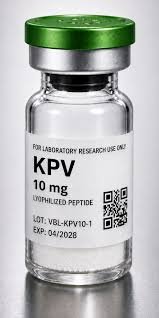
What Is KPV Peptide?
KPV is a tripeptide composed of lysine, proline and valine. It is an alpha-MSH fragment studied for its potential influence on inflammatory signaling. Research has explored its possible applications in gastrointestinal and skin-related conditions, although most findings remain at the cellular and animal research stages.
Full Name
Lys-Pro-Val (Lysine-Proline-Valine).
Peptide Type
Three-amino-acid tripeptide fragment of alpha-MSH.
Primary Research Area
Inflammatory signaling and immune-related research.
Additional Research Areas
Gastrointestinal and skin-related research.
Evidence Status
Evidence is mainly based on cellular and animal research. No completed human dose-finding trial establishes an official KPV protocol across different delivery formats.
Different Delivery Methods
Oral, topical, nasal and subcutaneous KPV delivery methods may produce different exposure and outcomes. There is no validated conversion between these routes.
Reported KPV Schedules
The following information summarizes community-reported subcutaneous amounts. These figures are unvalidated human dose examples and should not be interpreted as established treatment protocols.
SC example
Per administration
Frequency
Daily total
Reported cycle
Community SC — Lower Range
200 mcg
Daily (reported)
200 mcg/day
Not specified in source
Community SC — Higher Range
300–500 mcg
Daily (reported)
300–500 mcg/day
Not specified in source
Alternative Reported Amount
400 mcg
Daily (reported)
400 mcg/day
Not specified in source
Community SC — Lower Range
Per administration
200 mcg
Frequency
Daily (reported)
Reported cycle
Not specified in source
Community SC — Higher Range
Per administration
300–500 mcg
Frequency
Daily (reported)
Daily total
300–500 mcg/day
Reported cycle
Not specified in source
Alternative Reported Amount
Per administration
400 mcg
Frequency
Daily (reported)
Reported cycle
Not specified in source
The reported subcutaneous amounts are community examples, not clinically validated human doses. Oral and topical research contexts are separate, and no reliable cross-route conversion has been established.
No Established Human Protocol
No completed human dose-finding trial establishes an official KPV protocol. Preclinical inflammatory-signaling findings do not establish treatment effectiveness or an appropriate human dose.
KPV Safety Considerations
Human safety information for KPV remains limited. The available source does not establish validated human doses or reliable adverse-event frequencies. Delivery method, product quality and formulation should be considered separately.
KPV Storage Guidelines
Storage Conditions
Follow the manufacturer’s documented storage requirements for the specific KPV formulation.
Mixed Product Stability
A universal mixed-vial stability period has not been established in the source.
Product Quality
Product identity, purity and formulation documentation are important when evaluating research materials.
Documentation
Use product-specific stability and handling documentation rather than assuming that all KPV formulations have identical storage requirements.
KPV Concentration Calculator
Review mathematical concentration examples using different assumed peptide amounts and final volumes. These calculations are for educational reference only.
Amount (mg)
Final volume (mL)
Concentration (mg/mL)
Per 1 U (mcg)
Per 10 U (mcg)
Concentration (mg/mL)
2.5
U refers to a U-100 volume marking, where 1 U = 0.01 mL. Additional examples: 10 mg in 2 mL = 5 mg/mL, 50 mcg per 1 U and 500 mcg per 10 U; 10 mg in 3 mL = 3.333 mg/mL, 33.33 mcg per 1 U and 333.3 mcg per 10 U; 10 mg in 5 mL = 2 mg/mL, 20 mcg per 1 U and 200 mcg per 10 U. These are mathematical examples only, not mixing or administration instructions.
KPV Research Findings
Research on KPV has mainly focused on inflammatory signaling and potential gastrointestinal and skin-related applications. Most available findings are preclinical and do not establish clinical treatment effectiveness in humans.
Inflammatory Signaling
Cellular and animal research has investigated KPV’s potential influence on inflammatory signaling pathways. These findings provide research context but do not establish human treatment benefits.
Gastrointestinal Research
KPV has been discussed in gastrointestinal research, particularly in relation to inflammatory processes. Preclinical findings do not prove effectiveness for human digestive disorders.
Skin-Related Research
Skin-related research has explored KPV’s potential anti-inflammatory properties. Clinical evidence remains insufficient to establish reliable benefits for human skin conditions.
KPV Research and Regulatory Status
Evidence and Approval Limitations
The available evidence for KPV is mainly based on cellular and animal research. No completed human dose-finding trial establishes an official protocol across oral, topical, nasal or subcutaneous formats. Preclinical findings should not be interpreted as proof of human safety, effectiveness or regulatory approval.
This page is for educational and research-information purposes only. It is not medical advice, a prescription or a recommendation to use KPV. Consult a qualified healthcare professional for individual medical decisions.