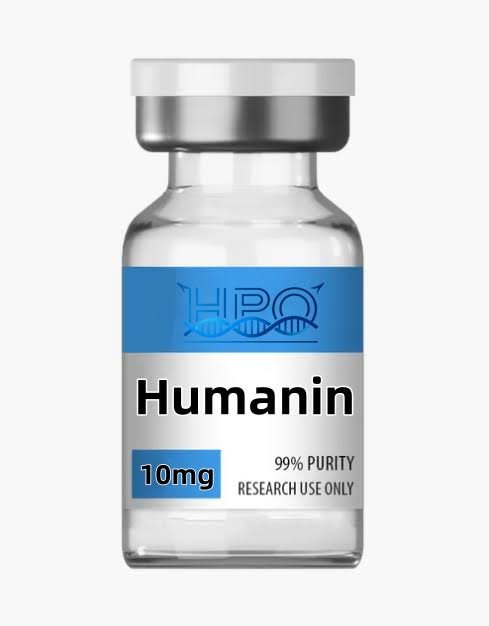
Understanding Humanin / HNG
Humanin is a mitochondrial-derived peptide discussed in cellular protection and metabolic research. HNG is a modified analog with a distinct identity and should not be treated as identical to native humanin.
Peptide Name
Humanin / HNG
Peptide Origin
Mitochondrial-derived peptide
Primary Research Focus
Cellular protection and metabolic biology
Related Form
HNG is a modified analog of native humanin.
Research Models
Animal studies and observational human research
Evidence Context
Animal findings and associations with circulating humanin levels do not establish a beneficial human injection regimen.
Native Humanin vs HNG
HNG is a modified analog, not interchangeable with native humanin. Research findings should be interpreted according to the exact peptide form studied.
Reported Research and Community Patterns
The source describes mouse HNG experiments and broad community-reported subcutaneous patterns. Animal study exposures are not human dosing recommendations, and community reports do not establish a validated human regimen.
SC example
Per administration
Frequency
Daily total
Reported cycle
Mouse Cardiac Study
4 mg/kg
Twice weekly
Not specified in source
14-month cardiac study
Mouse Metabolic Study
2.5 mg/kg
Twice daily
Not specified in source
Three days
Community-Reported SC Patterns
Milligram-range amounts; exact amount not specified
Daily to three times weekly
Not specified in source
Community-reported cycles of 4, 6–8 or 12 weeks
Per administration
4 mg/kg
Daily total
Not specified in source
Reported cycle
14-month cardiac study
Per administration
2.5 mg/kg
Daily total
Not specified in source
Reported cycle
Three days
Community-Reported SC Patterns
Per administration
Milligram-range amounts; exact amount not specified
Frequency
Daily to three times weekly
Daily total
Not specified in source
Reported cycle
Community-reported cycles of 4, 6–8 or 12 weeks
Mouse HNG examples are intraperitoneal (IP) research exposures. Community examples are subcutaneous (SC) reports. These routes and contexts are not interchangeable.
Animal and Community Data Only
No beneficial human injection regimen is established by the source. Animal findings and community-reported schedules should not be interpreted as validated human treatment protocols.
Safety Considerations
Humanin and HNG remain exploratory research subjects. The source does not identify a controlled human safety dataset for exogenous humanin, and findings involving native humanin should not automatically be applied to HNG.
Important Safety and Evidence Limitations
Storage and Research Monitoring
Storage
The source suggests keeping the product cold and protected from light.
Product Stability
Community-reported storage windows do not establish validated stability for human-use products.
Monitoring Considerations
Metabolic markers are discussed as exploratory research considerations.
Peptide Identity
Confirm whether research concerns native humanin or the modified HNG analog, as the two are not interchangeable.
Example Concentration Calculation
The source provides one independently recomputed mathematical concentration example. It is not a preparation or administration guide.
Amount (mg)
Final volume (mL)
Concentration (mg/mL)
Per 1 U (mcg)
Per 10 U (mcg)
U refers to a U-100 volume marking, where 1 U = 0.01 mL. These calculations are mathematical examples only, not mixing or administration instructions.
What Does the Research Show?
Human observational research has examined circulating humanin levels across different age groups and families with exceptional longevity. These associations do not establish that humanin injection improves health or treats disease.
Observational Plasma Research
Observational plasma studies have examined circulating humanin levels in human populations.
Age-Related Research
Observational plasma studies have examined circulating humanin levels in human populations.
No Established Injection Benefit
Endogenous humanin levels and stress responses do not establish a deficiency or prove that injection provides a clinical benefit.
Regulatory and Research Limitations
Experimental Research Status
Animal findings and observational human associations do not establish an effective or safe human injection regimen. The source does not provide controlled human safety evidence for exogenous humanin.
This page is for educational and research reference only. It is not medical advice or a recommendation to use Humanin or HNG.