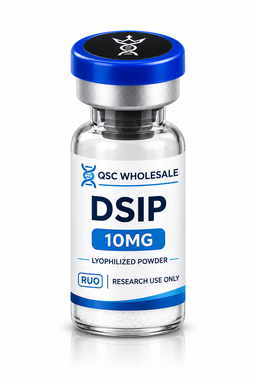
Understanding DSIP
DSIP is a sleep-related research peptide studied in older, small human trials. Results have been mixed, and the routes and treatment windows used in those trials differ from contemporary subcutaneous community schedules.
Research Category
Sleep-related research peptide
Older Human Trial Route
Intravenous (IV)
Older Human Trial Amount
25 nmol/kg
Reported Trial Duration
Approximately 4–7 nights
Community-Reported Route
Subcutaneous (SC)
Reported Community Timing
Typically in the evening, 1–3 hours before sleep
Important Research Limitation
Older human trials used routes and treatment windows that differ from contemporary subcutaneous community schedules.
Reported DSIP Schedules
The following are reported human-trial and community-use examples from the source. Longer community schedules lack trial validation.
SC example
Per administration
Frequency
Daily total
Reported cycle
Older Human IV Trials
25 nmol/kg
Approximately 4–7 nights
Community SC Range 1
100–200 mcg
5–7 nights
Community SC Range 2
200–300 mcg
Four weeks or 6–8 weeks
Per administration
25 nmol/kg
Reported cycle
Approximately 4–7 nights
Per administration
100–200 mcg
Reported cycle
5–7 nights
Per administration
200–300 mcg
Reported cycle
Four weeks or 6–8 weeks
Community durations of four weeks and 6–8 weeks lack trial validation.
Research Context Only
Older human IV trials do not validate contemporary subcutaneous community schedules. Reported schedules should not be interpreted as established treatment guidance.
Safety & Reported Concerns
Available safety information is limited. Small studies cannot define the long-term safety profile of DSIP.
Storage & Handling Information
Storage Protection
Cold and light protection recommended by the source.
Mixed-Product Stability
Exact mixed-product stability must be verified.
Monitoring Considerations
Sleep timing and sleep quality.
Additional Monitoring
Daytime effects; dated compounding claims need rechecking.
DSIP Concentration Calculator
Example calculation values from the source. These are not mixing or administration instructions.
Amount (mg)
Final volume (mL)
Concentration (mg/mL)
Per 1 U (mcg)
Per 10 U (mcg)
U means a U-100 volume marking: 1 U = 0.01 mL. These values are calculation examples, not mixing or administration instructions.
What Human Studies Report
Older insomnia trials were small, often enrolling only 6–14 people. Some reported modest sleep improvements, while others did not differ meaningfully from placebo.
Small Human Trials
Older insomnia trials often included only 6–14 participants.
Mixed Sleep Outcomes
Some studies showed modest sleep improvements, while others did not differ meaningfully from placebo.
Limited Withdrawal Evidence
Withdrawal studies were methodologically limited.
Regulatory & Research Status
Current Regulatory Check Required
The source notes that the page’s regulatory language is dated and requires a separate current check.
The source does not provide a current verified regulatory status for DSIP.