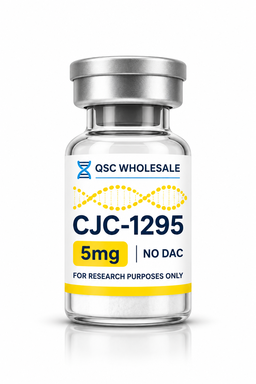
Understanding CJC-1295 with DAC
CJC-1295 with DAC is a long-acting GHRH analog. Its Drug Affinity Complex (DAC) modification supports albumin binding, prolonging exposure. Human research has examined its effects on growth hormone (GH) and insulin-like growth factor 1 (IGF-1). Biomarker changes do not establish benefits for general wellness, muscle gain, or other clinical outcomes.
Compound Type
Long-acting growth hormone-releasing hormone (GHRH) analog.
DAC Function
Albumin binding prolongs exposure compared with short-acting formulations.
Main Research Focus
Growth hormone and IGF-1 pharmacology.
Reported Half-Life
Approximately 5.8–8.1 days in the cited human research summary.
Reported Biomarker Changes
GH increased approximately 2–10-fold and IGF-1 approximately 1.5–3-fold in the cited study summary.
Evidence Limitation
Increased GH or IGF-1 does not prove general wellness, muscle-gain, or other long-term clinical benefits. Findings for CJC-1295 with DAC must not be treated as evidence for CJC-1295 without DAC.
Important Research Distinction
CJC-1295 with DAC and CJC-1295 without DAC are not interchangeable evidence categories. Check the exact compound identity when interpreting pharmacology, schedules, or study findings.
Reported Schedule Variations
The following are schedules reported in the source as community examples, alongside a separate trial ceiling. They are not validated personal-use instructions, and the source does not establish a safe or effective self-administration protocol.
SC example
Per administration
Frequency
Daily total
Reported cycle
Community Example: Initial Weeks
500–1,000 mcg weekly
Once weekly, as reported
Not applicable — the source reports a weekly amount.
Weeks 1–2: community-reported example.
Community Example: Subsequent Weeks
1,000 mcg weekly
Once weekly, as reported
Not applicable — the source reports a weekly amount.
Weeks 3–8: community-reported example.
Higher Reported Examples
2,000 mcg weekly, or 1 mg twice weekly
Weekly total or twice-weekly example; these are distinct reported patterns.
Not applicable — the source reports weekly schedules, not a validated daily total.
Other reported cycle patterns: 8–12 weeks followed by 4–6 weeks off, or 12–16 weeks followed by 6–8 weeks off.
Community Example: Initial Weeks
Per administration
500–1,000 mcg weekly
Frequency
Once weekly, as reported
Daily total
Not applicable — the source reports a weekly amount.
Reported cycle
Weeks 1–2: community-reported example.
Community Example: Subsequent Weeks
Per administration
1,000 mcg weekly
Frequency
Once weekly, as reported
Daily total
Not applicable — the source reports a weekly amount.
Reported cycle
Weeks 3–8: community-reported example.
Per administration
2,000 mcg weekly, or 1 mg twice weekly
Frequency
Weekly total or twice-weekly example; these are distinct reported patterns.
Daily total
Not applicable — the source reports weekly schedules, not a validated daily total.
Reported cycle
Other reported cycle patterns: 8–12 weeks followed by 4–6 weeks off, or 12–16 weeks followed by 6–8 weeks off.
The source also reports a trial ceiling of 240 mcg/kg/week. This is a study-specific figure, not a recommended dose. Community schedules and research-study conditions must be kept separate.
Not a Validated Treatment Protocol
These schedules are reported examples, not medical recommendations. The source does not establish that the listed community schedules, cycle lengths, or higher amounts are safe or effective. Do not use the trial ceiling as a personal dosing target.
Safety Considerations and Evidence Limitations
Long-term safety evidence is limited. Reported concerns include flushing, edema, headache, and glucose-related effects. Changes in GH and IGF-1 require careful interpretation and do not establish clinical benefit.
Storage and Handling Considerations
Storage Temperature
The source reports storage at 2–8°C for mixed product.
Storage Duration
A generic mixed-product storage duration is not established by the source; confirm product-specific stability information.
Product-Specific Guidance
Follow the exact product’s manufacturer or pharmacy instructions. Do not assume that all formulations have the same stability or storage requirements.
Monitoring Context
The source identifies IGF-1, glucose/A1c, and edema as monitoring considerations. Clinical interpretation should be handled by a qualified healthcare professional.
Illustrative Concentration Calculations
Review the arithmetic relationship between an assumed total amount, final volume, concentration, and U-100 volume markings. These are calculation examples only, not preparation or administration instructions.
Amount (mg)
Final volume (mL)
Concentration (mg/mL)
Per 1 U (mcg)
Per 10 U (mcg)
Example 1: 10 mg ÷ 1 mL = 10 mg/mL; at the stated U-100 volume convention, 1 U corresponds arithmetically to 100 mcg and 10 U to 1,000 mcg. Example 2: 10 mg ÷ 2 mL = 5 mg/mL; 1 U corresponds to 50 mcg and 10 U to 500 mcg. A third source example is 10 mg in 3 mL = approximately 3.333 mg/mL, 33.33 mcg per 1 U, and 333.3 mcg per 10 U. These are illustrative calculations only, not instructions to mix or administer the product.
What Human Research Reports
The source summarizes a 2006 study by Teichman and colleagues examining CJC-1295 pharmacology. The reported half-life and GH/IGF-1 changes describe biomarker responses; they do not establish long-term clinical outcomes.
Prolonged Exposure
The source reports a half-life of approximately 5.8–8.1 days for CJC-1295 with DAC in the cited human research summary.
Growth Hormone Response
The source reports GH increases of approximately 2–10-fold in the cited study summary.
IGF-1 Response
The source reports IGF-1 increases of approximately 1.5–3-fold. Biomarker elevation alone does not demonstrate a meaningful clinical benefit.
Regulatory Status and Research Limitations
Research Findings Are Not Proof of Clinical Benefit
The source describes human pharmacology research and community-reported schedules but does not establish that those schedules are approved treatments. Do not interpret GH or IGF-1 elevation as proof of improved wellness or muscle gain. Verify the exact compound identity, local regulatory requirements, and product status with appropriate qualified sources.
Educational content only. This page is not a substitute for medical advice, diagnosis, or treatment. Evidence for CJC-1295 with DAC must not be used as proof of the safety or effectiveness of CJC-1295 without DAC.