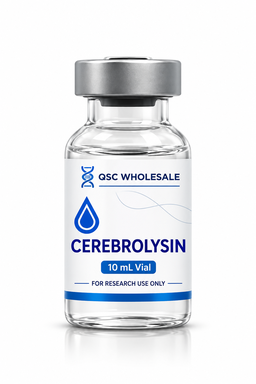
What Is Cerebrolysin?
Cerebrolysin is a porcine-brain-derived peptide mixture used as a clinical infusion or injection product in some countries. The source emphasizes that clinical ampoules measured in millilitres and research vials measured in milligrams represent different preparation and evidence contexts.
Product Type
Porcine-brain-derived peptide mixture
Clinical Contexts
Stroke, traumatic brain injury (TBI), and dementia are discussed in the source as clinical contexts.
Administration Forms
Clinical liquid ampoules used for infusion or injection in some countries
Evidence Summary
The source describes stroke evidence as mixed and reports that a 2023 Cochrane review found no clear benefit.
Safety Considerations
Infusion or injection reactions, seizure-related cautions, and severe renal-disease cautions are noted.
Key Limitation
Clinical liquid measured in mL cannot be assumed equivalent to a research vial measured in mg.
Do Not Equate Different Formulations
Clinical ampoule volumes and research-vial milligram amounts are not interchangeable. A generic peptide-vial concentration calculation cannot replace the exact finished-product information.
Clinical Uses & Reported Schedule Contexts
The source lists clinical liquid regimens reported in specific medical contexts and a separate community-reported milligram pattern. These must not be treated as equivalent formulations or as a personalized treatment schedule.
SC example
Per administration
Frequency
Daily total
Reported cycle
Stroke — Clinical Liquid
Source-reported range: 10–30 mL/day
Source describes IV administration
Not converted to mg; exact product concentration is required
Source-reported duration: 10–21 days
Traumatic Brain Injury — Clinical Liquid
Source-reported range: 30–50 mL/day
Source describes IV administration
Not converted to mg; exact product concentration is required
Source-reported duration: 10–21 days
Dementia — Clinical Liquid
Source-reported range: 5–30 mL/day
Source describes IV or IM administration
Not converted to mg; exact product concentration is required
Source-reported duration: approximately 4 weeks
Per administration
Source-reported range: 10–30 mL/day
Frequency
Source describes IV administration
Daily total
Not converted to mg; exact product concentration is required
Reported cycle
Source-reported duration: 10–21 days
Traumatic Brain Injury — Clinical Liquid
Per administration
Source-reported range: 30–50 mL/day
Frequency
Source describes IV administration
Daily total
Not converted to mg; exact product concentration is required
Reported cycle
Source-reported duration: 10–21 days
Dementia — Clinical Liquid
Per administration
Source-reported range: 5–30 mL/day
Frequency
Source describes IV or IM administration
Daily total
Not converted to mg; exact product concentration is required
Reported cycle
Source-reported duration: approximately 4 weeks
These ranges are transcribed from the source as clinical-context examples, not treatment recommendations. The source separately mentions a community vial pattern of 20, 24, 28, and 32 mg across weeks 1, 2, 3, and 4+, respectively. That milligram pattern is not clinically equivalent to the liquid-ampoule regimens.
Clinical Supervision Required
Cerebrolysin is a complex mixture, not a single generic peptide with a universal concentration. Do not convert clinical ampoule volumes to research-vial milligrams or substitute one formulation for another. Use the exact finished-product label and qualified clinical supervision.
Cerebrolysin Safety & Precautions
The source identifies infusion or injection reactions and cautions involving seizures and severe renal disease. Clinical use requires appropriate professional oversight.
Important Safety Cautions
Cerebrolysin Storage & Product Handling
Clinical Liquid Ampoules
Follow the storage conditions printed on the exact clinical product label. The source does not provide one universal storage specification for all products.
Opened Product
An opened clinical ampoule should not be treated as a multidose research vial. Follow the product-specific instructions.
Formulation
Clinical liquid ampoules and research vials measured in milligrams are different preparation contexts.
Handling Precaution
Use the exact finished-product concentration and route information. Do not assume a generic injectable concentration or substitute one formulation for another.
Product-Specific Concentration Information
Cerebrolysin is a peptide mixture available in clinical liquid formulations. Concentration calculations require the exact finished-product information; generic peptide-vial assumptions are not appropriate.
Amount (mg)
Final volume (mL)
Concentration (mg/mL)
Per 1 U (mcg)
Per 10 U (mcg)
No generic injectable concentration worksheet is supplied in the source. Use the exact finished-product concentration and route information. Clinical liquid and research-vial formulations must not be assumed equivalent.
What Does the Clinical Evidence Show?
The source describes mixed evidence for stroke and summarizes a 2023 Cochrane review that found no clear benefit and a signal for more nonfatal serious adverse events. These findings should be interpreted in their specific clinical context.
Mixed Stroke Evidence
The source characterizes the evidence concerning Cerebrolysin in stroke as mixed rather than establishing a clear, consistent benefit.
2023 Cochrane Review
The source reports that the 2023 Cochrane review found no clear benefit and identified a signal for more nonfatal serious adverse events.
Formulation Matters
Clinical ampoules measured in millilitres and research vials measured in milligrams represent different product and evidence contexts. Their amounts should not be treated as equivalent.
Regulatory Status & Limitations
Not Approved in the United States
The source states that Cerebrolysin is not approved in the United States. Regulatory status and permitted clinical use can differ by country. Check the relevant national regulator and the exact product information before making regulatory claims.
Educational information only. This page does not replace clinical guidance, official product labeling, or jurisdiction-specific regulatory information.