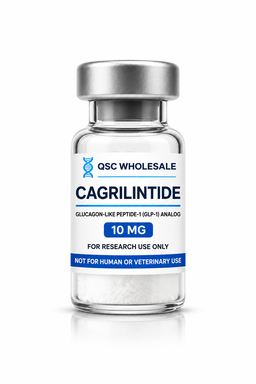
Understanding Cagrilintide
Cagrilintide is described in the source as a long-acting amylin analog discussed for appetite and weight management. The document reviews monotherapy and CagriSema studies and cautions that combination outcomes cannot be assigned to cagrilintide alone. Trial titration is not a personal escalation plan.
Compound Type
Long-acting amylin analog
Research Focus
Appetite and weight management
Study Contexts
Monotherapy and combination studies, including CagriSema
Reported Study Duration
The source lists duration examples of 16, 26–32, and 68 weeks.
Reported Safety Concerns
Nausea, local reactions, constipation, and gastric-emptying interactions
Key Limitation
Combination-trial outcomes cannot be attributed to cagrilintide alone. Trial titration is not a personal dose-escalation plan.
Interpret Each Trial in Its Own Context
The source reports monotherapy and combination-study findings separately. Results depend on the studied formulation, partner drug, dose, duration, and analysis method. The document also notes inconsistent estimand labels between the monotherapy and stack pages, so original trial analyses should be consulted when comparing results.
Cagrilintide Study Schedule Context
The source describes a weekly subcutaneous schedule ladder and notes that Phase 2 also studied doses up to 4.5 mg/week. These reported study schedules are not a personal treatment or dose-escalation plan.
SC example
Per administration
Frequency
Daily total
Reported cycle
Reported Weekly SC Study Schedule
Source-reported study schedule: 0.25 mg/week during weeks 1–4.
Weekly, as described in the source.
Not applicable as a daily total; the source describes a weekly amount.
Weeks 1–4 in the reported schedule.
Later Stages of Reported Schedule
The source lists 0.5 mg/week during weeks 5–8, 1 mg/week during weeks 9–12, and 1.7 mg/week during weeks 13–16.
Weekly, as described in the source.
Not applicable as a daily total; the reported schedule is weekly.
Weeks 5–16 across the listed study stages.
Later-Stage / Phase 2 Study Context
The source lists 2.4 mg/week from week 17 onward and separately notes Phase 2 study of doses up to 4.5 mg/week.
Weekly in the reported study context.
Not applicable as a daily total; amounts are reported per week.
The source lists duration examples of 16, 26–32, and 68 weeks. These are distinct study durations, not a universal treatment duration.
Reported Weekly SC Study Schedule
Per administration
Source-reported study schedule: 0.25 mg/week during weeks 1–4.
Frequency
Weekly, as described in the source.
Daily total
Not applicable as a daily total; the source describes a weekly amount.
Reported cycle
Weeks 1–4 in the reported schedule.
Later Stages of Reported Schedule
Per administration
The source lists 0.5 mg/week during weeks 5–8, 1 mg/week during weeks 9–12, and 1.7 mg/week during weeks 13–16.
Frequency
Weekly, as described in the source.
Daily total
Not applicable as a daily total; the reported schedule is weekly.
Reported cycle
Weeks 5–16 across the listed study stages.
Later-Stage / Phase 2 Study Context
Per administration
The source lists 2.4 mg/week from week 17 onward and separately notes Phase 2 study of doses up to 4.5 mg/week.
Frequency
Weekly in the reported study context.
Daily total
Not applicable as a daily total; amounts are reported per week.
Reported cycle
The source lists duration examples of 16, 26–32, and 68 weeks. These are distinct study durations, not a universal treatment duration.
The schedule and dose ranges are transcribed from the source as study context. Monotherapy and combination contexts differ. Do not use this table as a personal escalation plan or infer an individual treatment course from it.
Study Titration Is Not Personal Medical Guidance
The source describes weekly study schedules and Phase 2 research up to 4.5 mg/week. These figures do not establish an appropriate dose for an individual. Trial design, formulation, eligibility, and monitoring must be considered in the original study context.
Safety Concerns & Tolerability
The source reports nausea, local reactions, and constipation in the context of the 4.5 mg/week study dose, and notes potential interactions involving gastric emptying. The reported rates should not be generalized to every dose or formulation.
Reported Storage & Monitoring Context
Mixed Product Storage
The source reports 2–8°C for mixed storage over 28–30 days. It states that formulation-specific validation is needed.
Formulation Limitations
The reported storage period is not a universal stability guarantee. Validation depends on the specific formulation and product.
Monitoring Context
The source mentions gastrointestinal tolerability, nutrition, weight, and glucose as monitoring and interpretation considerations.
Storage Verification
The document does not establish storage stability for every formulation. Verify product-specific handling and storage information through appropriate manufacturer documentation.
Cagrilintide Concentration Calculation Examples
The source provides independently recomputed arithmetic examples using different assumed amounts and final volumes. These calculations are for reference only and are not instructions for mixing or administration.
Amount (mg)
Final volume (mL)
Concentration (mg/mL)
Per 1 U (mcg)
Per 10 U (mcg)
5 mg
2 mL
2.5 mg/mL
25 mcg
250 mcg
5 mg
3 mL
1.667 mg/mL
16.67 mcg
166.7 mcg
Concentration (mg/mL)
2.5 mg/mL
Concentration (mg/mL)
1.667 mg/mL
The source also lists 10 mg in 2 mL = 5 mg/mL, 50 mcg per 1 U, and 500 mcg per 10 U; and 10 mg in 3 mL = 3.333 mg/mL, 33.33 mcg per 1 U, and 333.3 mcg per 10 U. U refers to a U-100 volume marking, where 1 U = 0.01 mL. These are mathematical examples only—not mixing or administration instructions. For blends, total mass does not represent the amount of each individual ingredient.
What the Clinical Research Reports
The source reports 11.8% monotherapy weight loss at 68 weeks in REDEFINE-1. It also notes that the monotherapy and stack pages use inconsistent estimand labels, so the original trial analyses should be consulted before comparing results.
Reported Monotherapy Weight Loss
The source reports 11.8% weight loss at 68 weeks for the monotherapy context in REDEFINE-1. This is a study-level result, not a prediction of an individual’s outcome.
Reported Study Duration
The source identifies 68 weeks as the duration associated with the reported REDEFINE-1 monotherapy result. Other study durations listed in the document include 16 and 26–32 weeks.
Monotherapy vs Combination
Cagrilintide monotherapy findings must be distinguished from combination results. The source flags inconsistent estimand labels between the monotherapy and stack pages and recommends comparing original trial analyses.
Research Status & Evidence Limitations
Combination Results Cannot Be Assigned to Cagrilintide Alone
The source discusses both cagrilintide monotherapy and combination studies, including CagriSema. Outcomes from a combination cannot be attributed to cagrilintide alone. Reported study schedules are not personal dose-escalation plans, and storage claims require formulation-specific validation. The document also flags inconsistent estimand labels between its monotherapy and stack pages.
This page is for educational and research-reference purposes only. It is not personal medical advice or a treatment recommendation. Study schedules, weight-loss outcomes, concentration calculations, and storage claims must be interpreted within their specific research and product context. Consult a qualified healthcare professional for medical questions.