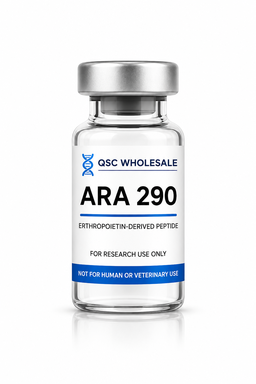
Understanding ARA-290 / Cibinetide
ARA-290 is described in the source as an erythropoietin-derived repair-signaling peptide studied for neuropathic symptoms. The document separates small clinical studies from commercial research vials and emphasizes that investigational research does not establish marketing approval or routine clinical benefit.
Alternative Name
Cibinetide
Research Background
An erythropoietin-derived repair-signaling peptide.
Research Focus
Neuropathic symptoms and nerve-fiber findings.
Clinical Evidence
Small developer-sponsored Phase 2 studies are described in the source.
Condition-Specific Findings
Macular-edema and other outcomes relate to specific study conditions, not proof of general tissue healing.
Key Limitation
Early findings do not establish routine clinical benefit or long-term safety.
Investigational Research Is Not Marketing Approval
The source distinguishes clinical-study findings from commercial research vials. An investigational designation does not establish marketing approval, general treatment effectiveness, or long-term safety. The proposed non-erythropoietic design does not guarantee safety.
ARA-290 Study Schedules & Reported Use
The source describes several route-specific clinical-study contexts and a separate community-reported use range. These reports should not be combined into a single treatment protocol.
SC example
Per administration
Frequency
Daily total
Reported cycle
IV Clinical Study Context
Source-reported study amount: 2 mg per administration.
Three times per week in the reported study context.
Not applicable as a daily total; the source describes three weekly IV administrations.
Four weeks in the reported study context.
Subcutaneous Study — Diabetes Neuropathy
Source-reported study amount: 4 mg/day.
Daily, as described in the source summary.
4 mg/day in the reported study context; not a personal-use recommendation.
28 days in the reported diabetes-neuropathy study context.
Other SC Studies & Community Reports
The source reports SC study contexts of 1, 4, and 8 mg/day for 28 days in sarcoidosis, and 4 mg/day for 12 weeks in macular edema. It separately notes community-reported amounts of 1–4 mg/day for roughly four weeks.
Daily in the reported SC study contexts and community summary.
Multiple amounts are reported for different contexts; they should not be interpreted as one standard daily amount.
Reported study durations include 28 days and 12 weeks; the community summary describes roughly four weeks.
IV Clinical Study Context
Per administration
Source-reported study amount: 2 mg per administration.
Frequency
Three times per week in the reported study context.
Daily total
Not applicable as a daily total; the source describes three weekly IV administrations.
Reported cycle
Four weeks in the reported study context.
Subcutaneous Study — Diabetes Neuropathy
Per administration
Source-reported study amount: 4 mg/day.
Frequency
Daily, as described in the source summary.
Daily total
4 mg/day in the reported study context; not a personal-use recommendation.
Reported cycle
28 days in the reported diabetes-neuropathy study context.
Other SC Studies & Community Reports
Per administration
The source reports SC study contexts of 1, 4, and 8 mg/day for 28 days in sarcoidosis, and 4 mg/day for 12 weeks in macular edema. It separately notes community-reported amounts of 1–4 mg/day for roughly four weeks.
Frequency
Daily in the reported SC study contexts and community summary.
Daily total
Multiple amounts are reported for different contexts; they should not be interpreted as one standard daily amount.
Reported cycle
Reported study durations include 28 days and 12 weeks; the community summary describes roughly four weeks.
These are distinct study contexts and community reports, not interchangeable protocols. Route, condition, study design, and evidence limitations matter. The source does not establish a universal or validated personal-use regimen.
Do Not Combine Different Study Contexts
The source reports different amounts and durations across IV and SC studies for different conditions. These figures are provided for research-reference context only. They do not establish a safe or effective regimen for an individual.
Safety Concerns & Limitations
The source describes local reactions and headache in small, short-duration trials. Long-term safety remains uncertain, and the proposed non-erythropoietic design does not guarantee safety.
Reported Storage & Monitoring Context
Source Powder Storage
The source reports storage at −20°C for powder. This claim is not independently validated in the document.
Mixed Product Storage
The source reports 2–8°C, protected from light, for approximately 14 days. This is a reported claim, not a verified stability guarantee.
Monitoring Context
The source mentions neuropathic symptoms and reactions as monitoring considerations.
Storage & Safety Limitations
The source does not independently validate storage claims or establish a complete long-term safety protocol. Verify product-specific information through appropriate professional and manufacturer documentation.
ARA-290 Concentration Calculation Example
The source provides one independently recomputed concentration example. It is an arithmetic reference only, not a preparation or administration instruction.
Amount (mg)
Final volume (mL)
Concentration (mg/mL)
Per 1 U (mcg)
Per 10 U (mcg)
16 mg
2 mL
8 mg/mL
80 mcg
800 mcg
Leave blank — no second example specified in the source.
Leave blank.
Leave blank.
Leave blank.
Leave blank.
Concentration (mg/mL)
8 mg/mL
Amount (mg)
Leave blank — no second example specified in the source.
Final volume (mL)
Leave blank.
Concentration (mg/mL)
Leave blank.
Per 1 U (mcg)
Leave blank.
Per 10 U (mcg)
Leave blank.
The source lists 16 mg in an assumed final volume of 2 mL, giving 8 mg/mL, 80 mcg per 1 U, and 800 mcg per 10 U. U refers to a U-100 volume marking, where 1 U = 0.01 mL. This is a mathematical example only—not a mixing or administration instruction. For blends, total mass does not represent the amount of each individual ingredient.
What the Research Reports
The source describes small developer-sponsored Phase 2 studies reporting neuropathic-symptom and nerve-fiber findings. Macular-edema and other outcomes were condition-specific and do not establish general tissue-healing benefits.
Small Clinical Studies
The source describes small developer-sponsored Phase 2 studies. These findings should be interpreted within the limitations of the individual studies.
Neuropathy-Related Findings
The source reports findings involving neuropathic symptoms and nerve fibers. It does not establish broad effectiveness for all neuropathic conditions.
Macular Edema & Other Outcomes
The source notes that macular-edema and other findings were tied to specific conditions. They should not be interpreted as proof of general tissue repair or healing.
Investigational Status & Evidence Limitations
Early Findings Do Not Establish Routine Clinical Benefit
The source describes ARA-290 / Cibinetide as an investigational research subject and distinguishes small clinical studies from commercial research vials. Investigational status does not establish marketing approval. Early findings do not confirm routine clinical benefit, general tissue-healing effects, or long-term safety.
This page is for educational and research-reference purposes only. Reported study amounts, community reports, storage claims, and concentration calculations are not medical advice or instructions for use. Consult a qualified healthcare professional for medical questions.