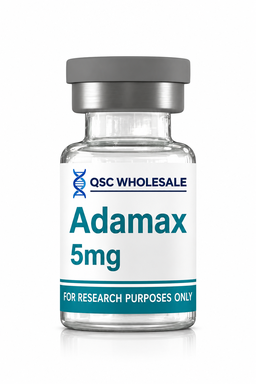
What Is Adamax?
Adamax is described as a modified Semax-related molecule marketed for cognition. The source identifies no direct published Adamax study. Findings about Semax cannot establish Adamax’s absorption, efficacy, safety, or appropriate dose escalation.
Compound description
Described in the source as a modified Semax-related molecule marketed for cognitive effects.
Research evidence
No direct published Adamax study was identified in the source.
Human evidence
No direct human study of Adamax was identified in the source.
Animal and laboratory evidence
No direct animal or laboratory study of Adamax was identified in the source.
Pharmacokinetics
Adamax-specific absorption and half-life have not been established in the source.
Evidence limitations
Claims of greater stability, potency, or duration than Semax remain unverified.
Important Evidence Limitation
Adamax-specific research is lacking in the reviewed reference. Semax findings must not be treated as proof of Adamax’s effects, absorption, safety, or dosing requirements.
Reported Community Schedules
The source describes an escalating subcutaneous schedule reported by the community. It has no direct clinical validation for Adamax and must not be interpreted as a recommended or established dosing protocol. The source also mentions commercial nasal products but provides no validated nasal or subcutaneous dose.
SC example
Per administration
Frequency
Daily total
Reported cycle
Community-reported subcutaneous schedule: weeks 1–2
Community-reported subcutaneous schedule: weeks 1–2
Daily, as reported
300 mcg/day, reported schedule only
Weeks 1–2; no direct clinical validation
Community-reported subcutaneous schedule: weeks 3–4
500 mcg daily, as reported by the source; not a validated dose
Daily, as reported
500 mcg/day, reported schedule only
Weeks 3–4; no direct clinical validation
Later stages of the reported community schedule
Source reports 750 mcg daily for weeks 5–6 and 1,000 mcg daily for weeks 7–8; neither amount is clinically validated
Daily, as reported
Source-reported amounts only; not a recommended daily total
Weeks 5–8, with increases described by the source; no direct clinical evidence supports escalation
Community-reported subcutaneous schedule: weeks 1–2
Per administration
Community-reported subcutaneous schedule: weeks 1–2
Frequency
Daily, as reported
Daily total
300 mcg/day, reported schedule only
Reported cycle
Weeks 1–2; no direct clinical validation
Community-reported subcutaneous schedule: weeks 3–4
Per administration
500 mcg daily, as reported by the source; not a validated dose
Frequency
Daily, as reported
Daily total
500 mcg/day, reported schedule only
Reported cycle
Weeks 3–4; no direct clinical validation
Later stages of the reported community schedule
Per administration
Source reports 750 mcg daily for weeks 5–6 and 1,000 mcg daily for weeks 7–8; neither amount is clinically validated
Frequency
Daily, as reported
Daily total
Source-reported amounts only; not a recommended daily total
Reported cycle
Weeks 5–8, with increases described by the source; no direct clinical evidence supports escalation
These are source-reported community practices, not validated Adamax dosing instructions. The source identifies no direct clinical evidence supporting the schedule or dose increases.
No Validated Adamax Protocol
No validated Adamax dose, route, escalation schedule, or treatment cycle has been established in the reviewed reference. Nasal and subcutaneous practices described by the source are untested community reports. Semax evidence cannot validate them.
Safety Considerations
The source reports no direct Adamax safety dataset. It mentions headache, irritability, sleep disturbance, and nasal or injection-site irritation. The frequency, severity, and causal relationship of these reports are not established.
Reported Storage Claims & Monitoring
Powder storage
The source reports storage at −20°C. This is a source-reported claim, not independently verified Adamax-specific stability guidance.
Mixed-product storage
The source reports 2–8°C and protection from light for mixed product. The exact usable period is not established.
Nasal-product storage
The source reports 2–8°C and protection from light for nasal products; product-specific stability and storage life remain unestablished.
Monitoring considerations
The source mentions mood, sleep, and nasal or injection-site irritation as monitoring considerations. It does not establish a validated Adamax-specific monitoring protocol.
Illustrative Concentration Calculation
The source provides one mathematical concentration example for Adamax. These values illustrate arithmetic only and do not establish a clinical dose, mixing procedure, or administration instruction.
Amount (mg)
Final volume (mL)
Concentration (mg/mL)
Per 1 U (mcg)
Per 10 U (mcg)
Leave blank
Leave blank
Leave blank
Leave blank
Leave blank
Concentration (mg/mL)
3.333
Final volume (mL)
Leave blank
Concentration (mg/mL)
Leave blank
Per 1 U (mcg)
Leave blank
Per 10 U (mcg)
Leave blank
Illustrative arithmetic only: the source assumes 10 mg and 3 mL, producing approximately 3.333 mg/mL. U-100 markings are volume units, not a clinical dose. These calculations do not establish that the assumed product or volume is appropriate for use.
What Does the Research Show?
The reviewed source identifies no direct human, animal, or laboratory study of Adamax. Its efficacy, safety, stability, potency, and duration therefore remain unverified.
Human Studies
No direct human study of Adamax was identified in the reviewed source. Human efficacy and safety have not been established.
Animal Studies
No direct animal study of Adamax was identified in the reviewed source. Results from Semax or other related compounds cannot substitute for Adamax-specific evidence.
Laboratory Studies
No direct laboratory study of Adamax was identified in the reviewed source. Claims of greater stability, potency, or duration than Semax remain unverified.
Regulatory Status & Evidence Boundaries
Research Claims Are Not Clinical Validation
The reviewed reference identifies no direct published Adamax study and does not establish its clinical efficacy or human safety. Evidence relating to Semax cannot automatically be applied to Adamax. This page summarizes reported claims and research limitations; it is not a treatment recommendation. The reviewed source does not establish a definitive jurisdiction-specific regulatory status for Adamax.
Educational reference only. Community-reported schedules, product descriptions, and storage claims should not be interpreted as proof of efficacy, safety, product quality, or regulatory approval. Consult appropriate qualified professionals for medical and regulatory questions.