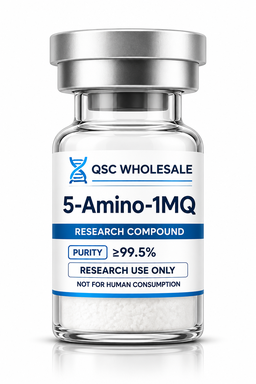
5-Amino-1MQ quick view.
A research-focused overview of 5-Amino-1MQ, its proposed mechanism, available evidence and limitations.
What it is
A small-molecule research compound discussed in connection with nicotinamide N-methyltransferase (NNMT) inhibition.
Evidence level
The available evidence and its limitations require review against primary research sources.
Human research
Human efficacy and safety findings need verification from reliable clinical sources.
Reported use
Research and reported-use claims should be distinguished from established clinical applications.
Formulations
Verify the specific formulation and product documentation.
Stacking
Combination claims require compound-specific evidence; do not assume combined benefits or safety.
Read this before the claims
Research findings do not establish that a compound is safe or effective for human use. Verify claims against primary sources and consult a qualified healthcare professional.
Research & reported use
Review the available evidence and distinguish research findings from clinically established recommendations.
SC example
Per administration
Frequency
Daily total
Reported cycle
Reported subcutaneous schedule variation A
Source reports 2.5 mg/day during days 1–2, followed by 5 mg/day from day 3 onward; not a validated human dose
Daily, as reported in the source
Source-reported amounts only; no validated human daily total
Days 1–2, followed by day 3 onward; human schedule not validated
Reported subcutaneous schedule variation B
Source reports 2.5 mg twice daily; not a validated human dose
Twice daily, as reported
5 mg/day mathematically, based on the reported amount; not a validated human regimen
No validated duration established for this alternative
Reported oral schedule variations
Source reports 50 mg/day for weeks 1–2, then 100 or 150 mg/day from week 3 onward; an alternative report is 50 mg in the morning and at midday. None is a validated human dose.
Daily; the alternative report describes two daily administrations
Source-reported oral amounts only; not a recommended daily total
Weeks 1–2 followed by week 3 onward, as reported; no validated human course established
Reported subcutaneous schedule variation A
Per administration
Source reports 2.5 mg/day during days 1–2, followed by 5 mg/day from day 3 onward; not a validated human dose
Frequency
Daily, as reported in the source
Daily total
Source-reported amounts only; no validated human daily total
Reported cycle
Days 1–2, followed by day 3 onward; human schedule not validated
Reported subcutaneous schedule variation B
Per administration
Source reports 2.5 mg twice daily; not a validated human dose
Frequency
Twice daily, as reported
Daily total
5 mg/day mathematically, based on the reported amount; not a validated human regimen
Reported cycle
No validated duration established for this alternative
Reported oral schedule variations
Per administration
Source reports 50 mg/day for weeks 1–2, then 100 or 150 mg/day from week 3 onward; an alternative report is 50 mg in the morning and at midday. None is a validated human dose.
Frequency
Daily; the alternative report describes two daily administrations
Daily total
Source-reported oral amounts only; not a recommended daily total
Reported cycle
Weeks 1–2 followed by week 3 onward, as reported; no validated human course established
No regimen should be presented as clinically established without supporting evidence.
How to read the evidence
Reported use, experimental findings and established clinical recommendations are not interchangeable. Verify the source and context of each claim.
Safety, exclusions & interactions
Review the evidence limitations, product-specific uncertainties and potential safety concerns before drawing conclusions.
Storage & product information
Storage
Follow verified, product-specific manufacturer documentation.
Product identity
Verify compound identity and available quality documentation.
Safety information
Review compound-specific safety evidence.
Regulatory status
Verify the applicable regulatory information for the product and intended use.
Product information worksheet
Record verified product specifications and source information.
Amount (mg)
Final volume (mL)
Concentration (mg/mL)
Per 1 U (mcg)
Per 10 U (mcg)
Product-specific information must be verified. This section does not provide preparation or administration instructions.
Research findings
Distinguish experimental findings from evidence of efficacy and safety in humans.
Cell & Mouse Research
The source describes cell and mouse work as supporting a research hypothesis. These findings do not establish efficacy or safety in humans.
Human Efficacy Trials
The source identifies no human efficacy trial establishing weight-loss benefits for 5-Amino-1MQ.
Human Pharmacokinetics
Rodent half-life estimates do not establish human dosing intervals, oral timing, or body-fat outcomes.
Regulatory & evidence limitations
Verify regulatory status
Regulatory status, permitted uses and available safety information must be verified using applicable official sources.
Research interest or a proposed mechanism does not establish clinical benefit, safety or an appropriate regimen.