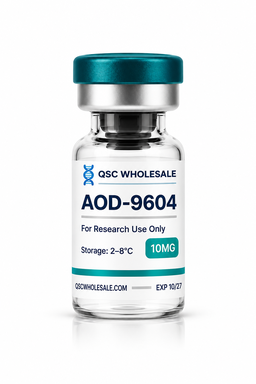
Understanding AOD-9604
AOD-9604 is described in the source as a growth-hormone fragment developed for fat-loss research. The document distinguishes oral clinical studies from community-reported subcutaneous use. A negative oral efficacy result does not establish benefit, and it does not define a safe dose for injected products.
Compound Type
Growth-hormone fragment
Research Context
Developed and studied in relation to fat loss
Oral Clinical Evidence
The largest reported oral efficacy study failed its primary weight-loss endpoint.
Injected Evidence
The subcutaneous schedules in the source are community examples, not the oral trial regimen.
Reported Safety Concerns
Headache, dizziness, and gastrointestinal symptoms are listed in the source.
Key Limitation
Oral study findings cannot establish the efficacy or safety of injected use.
Important Evidence Limitation
The source reports that the largest oral study failed its primary weight-loss goal. This does not prove that injected AOD-9604 is effective or safe. Route-specific evidence is essential, and the source does not establish a validated human injected regimen.
Reported AOD-9604 Schedule Patterns
The source lists community-reported subcutaneous schedules and separate oral clinical-study durations. These are different evidence categories. The reported injected schedules are not validated human treatment recommendations.
SC example
Per administration
Frequency
Daily total
Reported cycle
Community SC Example — Initial Period
Source-reported amount: 300 mcg/day for the first four weeks.
Source reports a daily schedule.
Source-reported daily amount: 300 mcg/day; not a validated human dose.
First four weeks of the reported community schedule; not a clinical recommendation.
Community SC Example — Weeks 5–12
Source-reported amount: 500 mcg/day during weeks 5–12.
Source reports a daily schedule.
Source-reported daily amount: 500 mcg/day; not a validated human dose.
Weeks 5–12 in the community-reported schedule.
Community SC Extension
Source-reported extension range: 300–500 mcg/day.
Exact extension frequency is not separately specified beyond the reported daily schedule.
Source-reported range: 300–500 mcg/day; not a validated human dose.
Community-reported windows include 8–12 weeks. The source also discusses 16-week calculations, but these are not oral clinical-trial regimens.
Community SC Example — Initial Period
Per administration
Source-reported amount: 300 mcg/day for the first four weeks.
Frequency
Source reports a daily schedule.
Daily total
Source-reported daily amount: 300 mcg/day; not a validated human dose.
Reported cycle
First four weeks of the reported community schedule; not a clinical recommendation.
Community SC Example — Weeks 5–12
Per administration
Source-reported amount: 500 mcg/day during weeks 5–12.
Frequency
Source reports a daily schedule.
Daily total
Source-reported daily amount: 500 mcg/day; not a validated human dose.
Reported cycle
Weeks 5–12 in the community-reported schedule.
Per administration
Source-reported extension range: 300–500 mcg/day.
Frequency
Exact extension frequency is not separately specified beyond the reported daily schedule.
Daily total
Source-reported range: 300–500 mcg/day; not a validated human dose.
Reported cycle
Community-reported windows include 8–12 weeks. The source also discusses 16-week calculations, but these are not oral clinical-trial regimens.
These values are transcribed from the source as reported community examples. They are not dosing recommendations. Oral Phase 2 studies lasting 12–24 weeks used a different route and must not be treated as evidence for the injected schedule.
Reported Does Not Mean Clinically Validated
The source distinguishes community-reported subcutaneous schedules from oral clinical trials. The oral efficacy study failed its primary weight-loss endpoint, and those results do not define a safe or effective injected dose. Do not interpret this table as personal medical guidance.
Safety Concerns & Evidence Limitations
The source lists headache, dizziness, and gastrointestinal symptoms among reported concerns. It emphasizes that safety findings from oral studies cannot be assumed to establish the safety of subcutaneous use.
Reported Storage Information
Source Powder Storage
The source reports −20°C for powder storage. This claim has not been independently validated in the document.
Mixed Product Storage
The source reports 2–8°C for a mixed product, with a reported duration of 3–4 weeks. This is a source-reported claim, not a verified stability guarantee.
Monitoring Context
The source mentions weight, glucose, and liver/renal markers. Route-specific evidence matters; validated human monitoring rules are not established here.
Evidence Limitation
Storage and stability claims are not independently validated by the source. Do not interpret them as product-specific storage instructions without verified manufacturer documentation.
AOD-9604 Concentration Calculation Examples
The source provides independently recomputed concentration examples using different assumed amounts and final volumes. These are arithmetic examples only, not mixing, preparation, or administration instructions.
Amount (mg)
Final volume (mL)
Concentration (mg/mL)
Per 1 U (mcg)
Per 10 U (mcg)
5 mg
1 mL
5 mg/mL
50 mcg
500 mcg
5 mg
2 mL
2.5 mg/mL
25 mcg
250 mcg
Concentration (mg/mL)
5 mg/mL
Concentration (mg/mL)
2.5 mg/mL
The source also lists these examples: 5 mg in 3 mL = 1.667 mg/mL, 16.67 mcg per 1 U, and 166.7 mcg per 10 U; 2 mg in 1 mL = 2 mg/mL, 20 mcg per 1 U, and 200 mcg per 10 U; 10 mg in 3 mL = 3.333 mg/mL, 33.33 mcg per 1 U, and 333.3 mcg per 10 U. U refers to a U-100 volume marking, where 1 U = 0.01 mL. These are calculation examples only—not instructions for mixing or administration. For a blend, total mass does not represent the amount of each individual ingredient.
What the Human Study Found
The source identifies METAOD006 as a study involving 502 adults, with oral doses of 0.25, 0.5, or 1 mg daily over 24 weeks. The primary weight-loss endpoint was not met. The source also notes that roughly 900 participants across earlier trials do not validate injected efficacy.502
Adults in METAOD006
The source reports that METAOD006 involved 502 adults. This is a study-participant count, not evidence that treatment was effective.
Oral Study Duration
The source reports oral study doses of 0.25, 0.5, or 1 mg daily for 24 weeks. The primary weight-loss endpoint failed.
Injected Efficacy
The source states that oral trial results and participant totals do not validate the efficacy of subcutaneous AOD-9604. Route-specific evidence remains essential.
Approval Status & Research Limitations
Research Evidence Is Not Proof of Treatment Benefit
The source reports that the largest oral AOD-9604 efficacy study failed its primary weight-loss endpoint. Community-reported subcutaneous schedules are not the same as oral clinical-trial regimens. The document does not establish a validated human injected dose, a proven injected weight-loss benefit, or a complete route-specific safety profile.
This page is for educational and research-reference purposes only. Reported schedules, storage claims, and calculation examples should not be treated as medical advice or instructions for use. Oral clinical findings should not be extrapolated to injected products. Consult a qualified healthcare professional for medical questions.