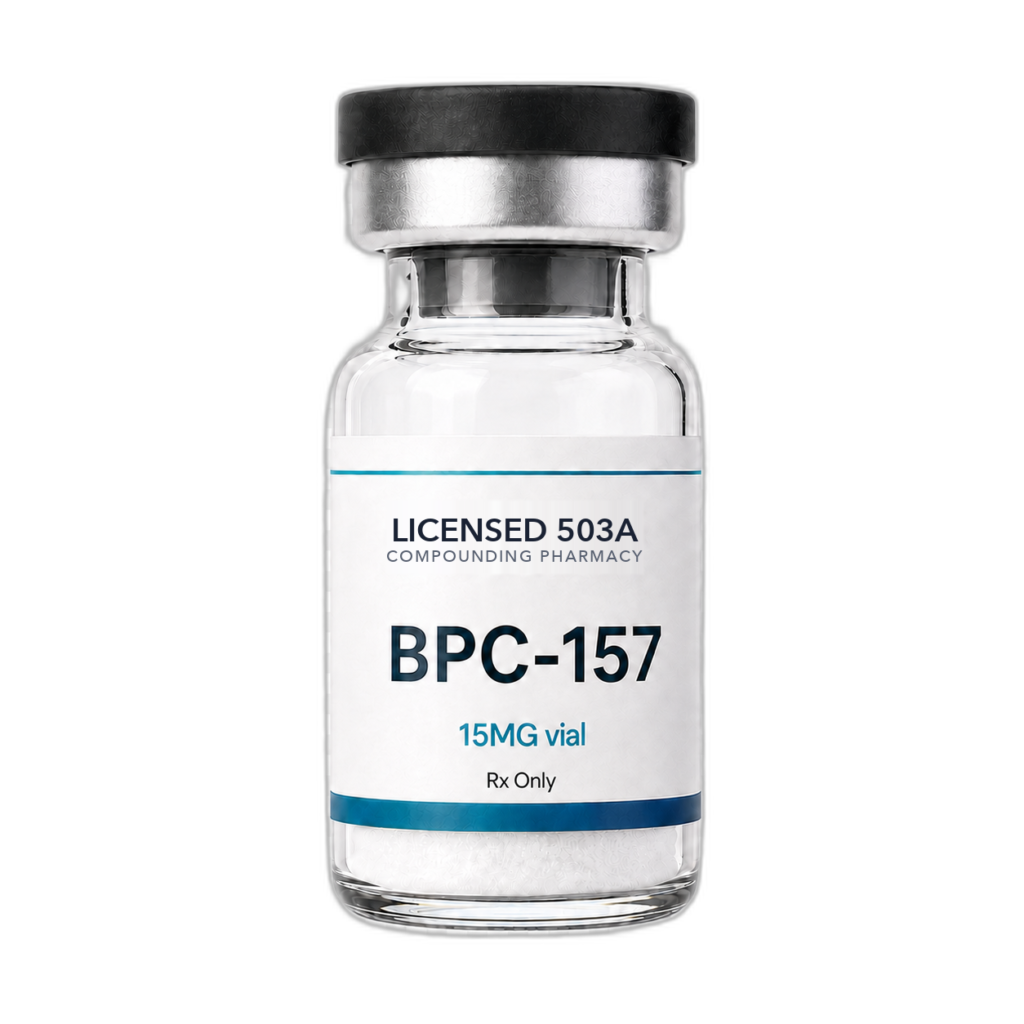
BPC-157 quick view.
The short version of what the site reports. Every number below is a reported example, not a recommendation.
What it is
A gastric-sequence peptide discussed for tendon, gut and tissue-repair biology.
Evidence level
Predominantly preclinical, with limited human reports. No established human dose-finding for subcutaneous schedules.
Reported SC examples
250 mcg once a day · 250 mcg twice a day · 500 mcg twice a day.
Reported cycle length
4–6, 6–8 or 8–12 weeks.
Oral formats
Discussed separately. An oral product is a different formulation question from an injected vial.
Stacking
Appears in Wolverine, GLOW and KLOW blends. No combined-product trial exists.
Read this before the numbers
The page this guide is based on says its subcutaneous schedules lack human dose-finding validation. A range here is a description of what is reported, not a dose chosen for you.
Dosing pattern & schedule.
Three subcutaneous patterns reported by the site, with the daily total each one adds up to.
SC example
Per administration
Frequency
Daily total
Reported cycle
Pattern A
250 mcg
Once/day
250 mcg
4–6 weeks
Pattern B
250 mcg
Twice/day
500 mcg
4–6 weeks
Pattern C
500 mcg
Twice/day
1,000 mcg
4–6 weeks
Per administration
250 mcg
Per administration
250 mcg
Per administration
500 mcg
Label status: COMMUNITY. These are not clinically established regimens. Oral formats are discussed separately.
How to read the table
Where a range is shown, it describes what people report, and some of it comes from animal work or small human pilots. Check any actual product label or your clinician’s instruction first.
Safety, exclusions & interactions
Read this section before anything else on the page.
Storage & monitoring
Storage claim
Source: mixed, 2–8 °C. No validated universal beyond-use period.
Monitoring
Symptoms, blood pressure.
Pregnancy & cancer
Cautions apply.
Athletes
Prohibition is discussed.
Concentration worksheet
Independently recomputed from the numerical inputs.
Amount (mg)
Final volume (mL)
Concentration (mg/mL)
Per 1 U (mcg)
Per 10 U (mcg)
Concentration (mg/mL)
3.333
U means a U-100 volume marking: 1 U = 0.01 mL. For a blend, total mass is not the amount of each ingredient. Separate-component arithmetic remains separate. These inputs are examples, not mixing or administration instructions.
Clinical findings
Different routes and tiny cohorts cannot establish general efficacy or safety.
Knee pain
12-person human report.
Bladder
12-woman human report.
IV pilot
Two-adult intravenous pilot.
FDA evidence boundary
FDA safety context
FDA describes limited safety information for BPC-157 and potential immunogenicity and impurity/characterization concerns. Its safety page identifies no human exposure data for the thymosin beta-4 fragment sold as TB-500.
In combined stacks (Wolverine, GLOW, KLOW), a plausible mechanistic rationale does not demonstrate added benefit, combined safety, a validated component ratio, or the right cycle length.