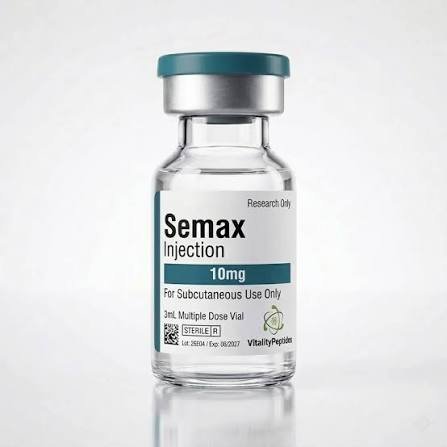
Understanding Semax
Semax is a synthetic ACTH-fragment analog studied in neurological and cognitive research. Its nasal formulation has the most direct clinical context in the reference, including research involving stroke and healthy volunteers. Subcutaneous community reports represent a separate and less-established context.
Compound Type
Synthetic ACTH-fragment analog
Research Focus
Neurological and cognitive research
Main Research Route
Intranasal
Other Reported Route
Subcutaneous community reports; evidence is particularly sparse.
Evidence Status
Limited clinical research, including acute-stroke work and small healthy-volunteer imaging or cognitive studies.
Important Route Distinction
Nasal clinical research does not establish the effectiveness or safety of injected research-vial schedules. Concentration per spray or drop must be determined from the specific product rather than inferred from the compound name.
Semax Research and Use Patterns
The reference describes nasal cognitive research, a single healthy-volunteer exposure, hospital-supervised stroke regimens and separate subcutaneous community reports. These contexts are not interchangeable and should not be interpreted as personal treatment instructions.
SC example
Per administration
Frequency
Daily total
Reported cycle
Nasal Cognitive Research
Approximately 0.6–1.5 mg/day
Split between morning and early afternoon
Approximately 0.6–1.5 mg/day
10–14 days, or 4–6 weeks with 2–4 weeks off
Healthy-Volunteer Research
Approximately 1.2 mg single exposure
Single exposure
Not applicable — single exposure
Single research exposure
Subcutaneous Community Reports
Sub-milligram per administration; exact amount varies across reports.
Frequency not specified in source
Not specified in source
Community-reported courses; exact cycle details vary.
Per administration
Approximately 0.6–1.5 mg/day
Frequency
Split between morning and early afternoon
Daily total
Approximately 0.6–1.5 mg/day
Reported cycle
10–14 days, or 4–6 weeks with 2–4 weeks off
Healthy-Volunteer Research
Per administration
Approximately 1.2 mg single exposure
Frequency
Single exposure
Daily total
Not applicable — single exposure
Reported cycle
Single research exposure
Subcutaneous Community Reports
Per administration
Sub-milligram per administration; exact amount varies across reports.
Frequency
Frequency not specified in source
Daily total
Not specified in source
Reported cycle
Community-reported courses; exact cycle details vary.
Stroke research used higher hospital-supervised amounts. Those regimens are not routine cognitive-use schedules. Rodent research amounts are not human doses.
Research Context Is Not a Prescription
Nasal research, hospital-supervised stroke treatment and subcutaneous community reports have different evidence levels. No route or schedule should be transferred from one context to another without appropriate clinical evidence.
Semax Safety Considerations
The reference describes nasal irritation, headache and stimulation or sleep-related effects. Safety information for subcutaneous use is particularly limited.
Semax Storage and Product Handling
Powder Storage
The source describes frozen storage at approximately −20°C for powder.
Mixed Formulation
The source describes refrigerated storage at approximately 2–8°C after mixing.
Light and Oxidation Protection
Semax solutions are described as light-sensitive and oxidation-sensitive. Protection from light is emphasized.
Storage Duration
A universal usable period after mixing is not established in the source. Product-specific stability documentation should be consulted.
Semax Concentration Calculator
The reference provides independently calculated examples using a 20 mg assumed amount and different final volumes. These examples demonstrate concentration arithmetic only. They do not establish a suitable nasal spray, drop concentration or injectable formulation.
Amount (mg)
Final volume (mL)
Concentration (mg/mL)
Per 1 U (mcg)
Per 10 U (mcg)
20
2
10 mg/mL
100 mcg
1,000 mcg
20
4
5 mg/mL
50 mcg
500 mcg
Concentration (mg/mL)
10 mg/mL
Concentration (mg/mL)
5 mg/mL
Source examples: 20 mg / 2 mL = 10 mg/mL; 20 mg / 4 mL = 5 mg/mL; 20 mg / 5 mL = 4 mg/mL. U means a U-100 volume marking: 1 U = 0.01 mL. These are mathematical examples, not mixing or administration instructions. Nasal spray output and drop volume require product-specific measurement and cannot be inferred from U-100 syringe markings.
Semax Clinical Findings
The reference identifies acute-stroke research and small healthy-volunteer imaging or cognitive studies. These findings represent different research populations and outcomes, and they do not establish general cognitive enhancement in healthy users.
Acute-Stroke Research
The source cites acute-stroke research involving Semax. Hospital-supervised neurological treatment is a distinct context from general cognitive use.
Healthy-Volunteer Studies
Small healthy-volunteer imaging and cognitive studies have examined acute exposure and related outcomes.
Evidence Limitations
Neurological patient outcomes, biomarker changes and healthy-user cognitive enhancement are not equivalent. The available studies do not establish a proven long-term cognitive benefit.
Semax Regulatory Status
Regional Research and Use Context
The reference describes Russian clinical and neurological research contexts for Semax. It does not establish universal regulatory approval or equivalence between nasal clinical formulations and independently sourced research-vial products.
Educational information only. Not medical advice, diagnosis or treatment guidance. Research findings and community-reported practices should not be interpreted as proof of safety or effectiveness. Consult a qualified healthcare professional for medical questions.