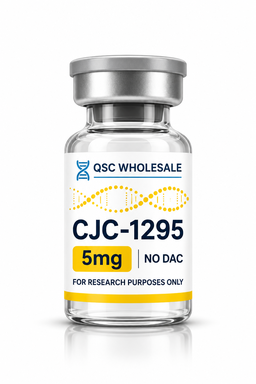
Understanding CJC-1295 without DAC
The source treats CJC-1295 without DAC schedules as illustrative community examples. Trials of long-acting CJC-1295 with DAC do not establish the short-acting product’s half-life, dose, fasting requirement, or cycling benefits. Product identity matters when interpreting research.
Compound Identity
CJC-1295 without DAC, discussed separately from the long-acting DAC form.
Reported Administration
The source describes an illustrative once-daily subcutaneous schedule.
Half-Life
A validated half-life for the No-DAC product is not established in the source.
Fasting Requirements
Fasting practices lack direct validation.
Cycling Practices
Cycling benefits and 5-days-on/2-days-off practices lack direct validation.
Research Limitations
Human Teichman/Ionescu studies concern DAC. Mouse growth studies and human DAC observations cannot validate the displayed No-DAC course, fasting rules, or breaks.
Important DAC vs No-DAC Distinction
Long-acting CJC-1295 with DAC trial findings cannot establish the half-life or regimen of CJC-1295 without DAC.
Community-Reported Schedule Examples
The source lists an illustrative once-daily subcutaneous schedule. Other fasted, bedtime, split-dose, and 5-on/2-off practices lack direct validation.
SC example
Per administration
Frequency
Daily total
Reported cycle
Initial Period
100 mcg
Once daily — reported example
100 mcg/day
Weeks 1–2
Intermediate Period
150 mcg
Once daily — reported example
150 mcg/day
Weeks 3–4
Later Period
200 mcg
Once daily — reported example
200 mcg/day
Weeks 5–8
Per administration
100 mcg
Frequency
Once daily — reported example
Per administration
150 mcg
Frequency
Once daily — reported example
Per administration
200 mcg
Frequency
Once daily — reported example
These are illustrative community-reported examples, not validated treatment instructions. Fasting, bedtime, split-dose, and 5-on/2-off practices lack direct validation.
Unvalidated Community Schedules
The source does not establish the safety or effectiveness of the reported No-DAC schedule, fasting requirements, or cycling practices. DAC trial findings cannot validate this regimen.
Safety Considerations and Risks
The source discusses local reactions and growth-hormone-related risks. DAC adverse-event data are not validation of No-DAC safety.
Storage and Monitoring Context
Storage Requirements
Formulation-specific stability information is required.
Usable Period
No established generic usable period is provided in the source.
Product Stability
Storage stability must be confirmed for the exact formulation.
Monitoring Context
The source identifies IGF-1 and glucose monitoring considerations. Fasting, cycling, and desensitization claims are unproven.
Illustrative Concentration Calculations
The source provides independently recomputed concentration examples using assumed amounts and final volumes. These are arithmetic examples, not preparation or administration instructions.
Amount (mg)
Final volume (mL)
Concentration (mg/mL)
Per 1 U (mcg)
Per 10 U (mcg)
Example 1: 2 mg / 1 mL = 2 mg/mL, 20 mcg per 1 U, and 200 mcg per 10 U. Example 2: 2 mg / 2 mL = 1 mg/mL, 10 mcg per 1 U, and 100 mcg per 10 U. The source defines 1 U as a U-100 volume marking equal to 0.01 mL. Additional source examples include 5 mg/2 mL, 5 mg/3 mL, 5 mg/5 mL, 10 mg/3 mL, and 10 mg/5 mL. These are calculation examples only, not mixing or administration instructions.
Research Findings and Limitations
The source separates No-DAC community schedules from human research involving DAC. Human Teichman/Ionescu studies concern DAC, while mouse growth studies cannot validate the No-DAC course.
Human DAC Studies
Human Teichman/Ionescu studies cited in the source concern CJC-1295 with DAC.
Mouse Growth Studies
Mouse growth studies do not establish a validated human No-DAC schedule.
No-DAC Evidence Gap
Available findings cannot validate the displayed No-DAC course, fasting rules, or breaks.
Research Status and Limitations
No-DAC Schedule Is Not Validated
The source presents No-DAC schedules as illustrative community examples. It does not establish a validated half-life, dose, fasting requirement, cycling benefit, or generic usable storage period for this product.
Educational information only. Human DAC studies and mouse growth studies cannot be used to validate No-DAC schedules or treatment outcomes.